Tel: 07840 341 227


Our Friends













Tri-Adventure – What is Adventure Racing and learn about our events
If someone asked me to define what Adventure is to me, I would reply that hte definition is that the outcome is unknown!
There are many unknowns when you sign up to an Adventure Race other than an event HQ location. Who else will turn up? what will the weather be like? where will I be heading? what activities will I be doing? what will my strategy be? how far will I run? what position will I finish? These unknowns are what make the sport of Adventure Racing so exciting.
You often will not see the course map to plan where you will go until you register on the day at the event. There will usually then be a bit of time to study the map and think through strategy before starting your race. The results are often governed by how many points you collect rather by time. Test your stamina and strategy on an off road adventure. Navigate trails and hills on foot and bike collecting as many check points within the time limit.
Below are previous examples of the map you will receive when you register at a Tri-Adventure Event. The skill is to visit as many of the checkpoints pre-marked on the maps, each worth 10 points each within the time limit. The map is double sided for the Run/Bike events. Our events all currently start on the run. Click on the map to enlarge.

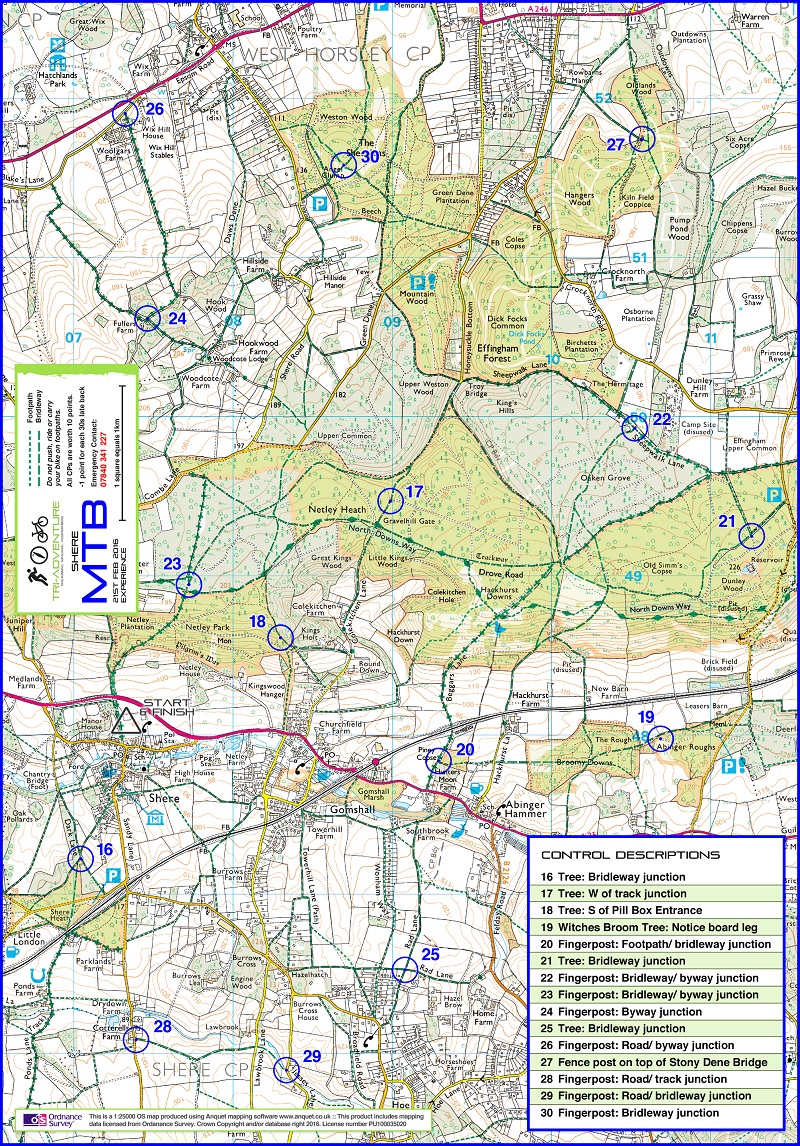
You must stay on public rights of way and you are not allowed to ride your bikes on footpaths. Public rights of way are marked on the maps. The Checkpoints in Tri-Adventure Events can be visited in any order. So, you can set your own level of challenge by your goals of how many to visit.
Don’t be too late back! Points are lost for being late back to the finish. In Tri-Adventure events this will be -1 point for every 30s after the finish time. Use your skills to evaluate whether collecting an extra checkpoint towards the end and being late back is worth while. For example, if you collect a checkpoint which results in you being 4m59s late back to the finish, you will have lost the value (10 points) of the checkpoint and as a result be catagorised below if you had arrived back on time with one less checkpoint. However if you make it back in 4m29s, you will have earnt the 10 points from the checkpoint and lost 9 points for being late. You will however, be 1 point up than if you had come straight back within the time limit.
This leads on to mention that since everyone starts as a mass, and all are trying to maximise their points within the event time limit, the finish is an exciting busy place as most will finish within a 10 minute timing window. This creates a real buzz as people discuss their route choices and mistakes made.
Results and current placings are instantaneously printed out on a till receipt and projected on the wall when you download your dibber at the desk.
Minimum age to take part in an Experience event is 16.
Registration process: This is where you sign in,collect your map, race number and timing dibber. The timing dibber will be attached to your wrist.
Planing time: Don’t be afraid to ask! Tri-Adventurers will often be happy to share route plans and information, particularly if you are new t the sport. Have a highlighter and/or a permanent marker to mark your map. The maps themselves are waterproof. Have an idea of how fast you are on the bike and on the run. With this information you can plot an intended route of attack. Always think how you could get back early if you find yourself short of time. Have a read through the control descriptions to familiarise yourself with the checkpoint locations. You alos need to rack your bike in the Transition area.
The event itself: At the mass start you will be amazed that competitors will all run in different directions as each will have their own plan for the event. When you locate a checkpoint you must insert your dibber into the control box and wait for it to beep. There may be a 1 second delay if you are the first to visit a control box as it wakes up. If you are competing in the Run/Bike event you will Transition. Transition is where you change from one discipline to another and must be done having collected a minimum of on Run checkpoint. In Tri-Adventure events this is from run to bike. You must dib in the Transition In control box as you enter Transition. You must also dib out as you leave Transition. You do not score any points for visiting Transition, your Transition time is included within you event time, so, speed is of the essence. For reference, competitor Transition times are ranked by speed and displayed with the results. To qualify in the results a minimum of one checkpoint must be visited on each discipline.
Download Process: After you have completed your event, download your dibber at the registration desk, collect your Results with splits and enjoy a cup of tea/coffee and a cake.
Prizes: These are awarded to the highest points scorers in each category. If points are tied, then a competitor with a shorter time is ranked higher.
Series Results: Spread over a number of events, an explanation of Series calculations is given below.
Time: Registration opens at 08:30am, event will start 10:00am.
The event
- Visit the registration desk to collect your race pack and SPORTident dibber.
- Ensure you allow enough time to register.
- The start will be on foot with just one transition allowed to the bike.
- Using your map, navigate to as many checkpoints as possible, and cover as much distance as you can within the 4 hour limit.
- Please note in some courses there could potentially be mandatory checkpoints. These will be advised at registration.
- There will be a number of checkpoints to collect set over a course of approximately 20km trail run and 40km mountain bike.
- Competitors must collect a minimum of one run and one bike checkpoint to qualify.
- All checkpoints have a value of 10 points each.
- Competitors will incur a penalty of 1 point per 30 seconds they are late back.
Series Calculations – When the event is part of a series, the competitors score is calculated on a percentage of the winning score at the same event. The resulting percentage from each event is then culminated across the Series. A minimum of 2 events in the series must be entered to qualify, this highest total percentages wins.
Why is it done in this way? Well, if one event is a wash out with really sticky mud, the winner may only visit 20CPs and therefore be awarded 100%. Someone who collects 10CPs at the same event will achieve 50%, etc. If the next event is dry and fast, the winner may visit all 30CPs and be awarded 100%. Someone who only visits 20CPs will be awarded 66%. 20CPs at a dry event could be far easier that on a wet day. This makes for a fair calculation over all the events in the series. Entering all the events will be a significant advantage over someone who misses one as all events count in the total.
Kit, Rules & Penalties • Ask us a Question • New to AR? • Mountain Bike Hire
Contact Us
Follow us on YouTube
Follow us on Instagram
Follow us on Twitter
Become a Fan on Facebook